
680,600 Users Lost: A Bumble MarkOps Audit
Tracing brand collapse through public data, SEO intelligence, and CRM analysis
The Story
Bumble launched with one of the most compelling differentiators in the history of dating apps — women make the first move. It was bold, it was timely, and for a while, it worked. At its peak, Bumble had over 50 million users and was widely seen as the thoughtful alternative to Tinder.
Then something went wrong.
In 2024, Bumble rebranded, introduced “Opening Moves” — a feature that quietly walked back its women-first mechanic — and cut its marketing budget by nearly half. The result was swift: 680,600 paying users lost in a single quarter, US revenue down 17.6% year-over-year, and a $408 million impairment loss written off in the first nine months of 2025.
I’ve used Bumble BFF personally — the friendship-matching feature that, like the core app, had a genuinely great idea behind it and struggled to capture the audience it deserved. That gap between potential and execution is what drew me to this project. I wanted to understand not just that Bumble was failing, but where the marketing operations broke down and what a data-backed recovery would actually look like.
Part 1 — The Data
All data in this project is sourced from publicly available information. Bumble’s SEC EDGAR 10-Q filing (Q3 2025) formed the financial backbone of the analysis. It is worth noting that Bumble stopped publishing detailed user metrics in their public reports — the absence of MAU (Monthly Active Users) data is itself a signal. When a company stops reporting a metric, it is usually because the number has become uncomfortable to share.
From the SEC filing, I extracted and cleaned six datasets across revenue, gross profit, paying users, geographic breakdown, marketing spend, and stock-based compensation. The data was structured in Zoho Sheets with calculated fields for gross margin, implied churn rate, and selling & marketing spend as a percentage of revenue.
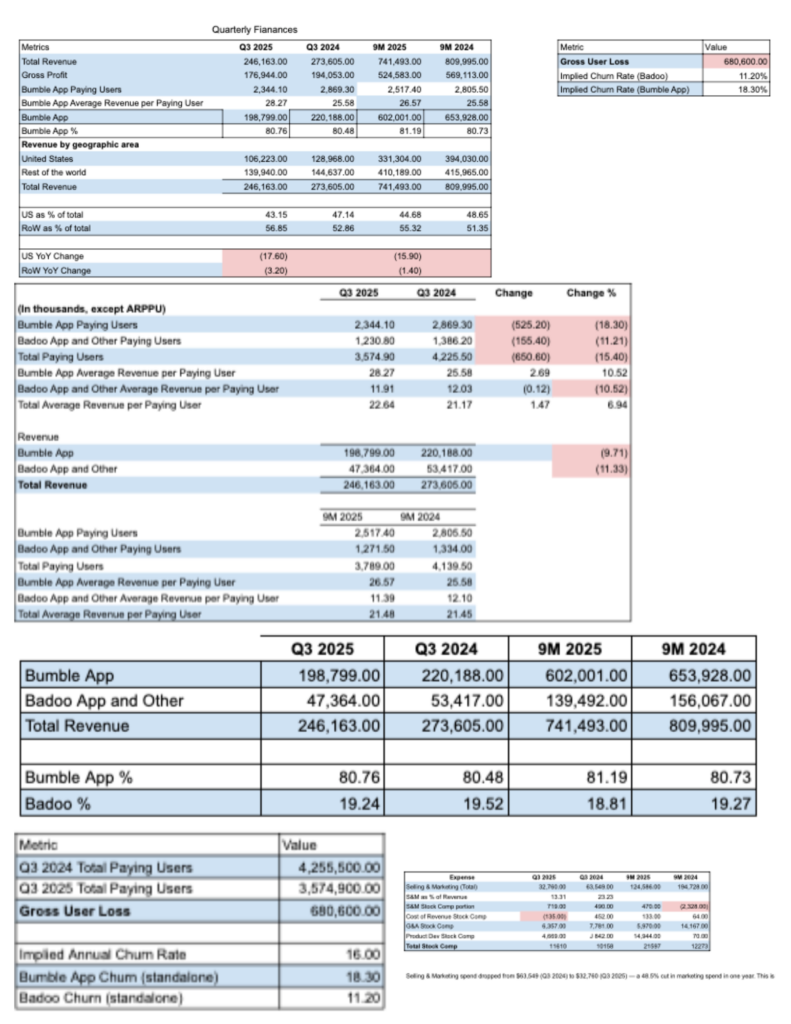
The three numbers that tell the story:
- Selling & marketing spend fell from $63.5M to $32.8M in one year — a 48.5% cut
- Bumble App paying users dropped from 2,869,300 to 2,344,100 — an 18.3% implied churn rate
- US revenue declined 17.6% year-over-year while international revenue fell only 3.2% — the brand failed hardest in the market that knew it best
To understand why users were leaving, I supplemented the financial data with sentiment analysis drawn from Trustpilot, Reddit (r/Bumble, r/dating_advice), and verified press coverage. The findings revealed recurring, Bumble-specific failure points: arbitrary account bans with no appeals process, billing traps flagged with the BBB, blocked users reappearing in feeds (confirmed by a Bumble support rep and reported by Rolling Stone), and a GDPR complaint filed by advocacy group NOYB over AI data privacy. These are not product bugs — they are trust failures, and trust failures drive churn.
Sources for the files can be found here: ‘Master sheet‘ and ‘Data sheet‘
Part 2 — The SEO Audit
A 97/100 on-page SEO score sounds healthy. It is not the full picture.
Using Ubersuggest, Ahrefs, Screaming Frog, SimilarWeb, and SEOquake, I conducted a full technical and competitive SEO audit of bumble.com. What the headline score hides is a content and strategy failure of significant scale.
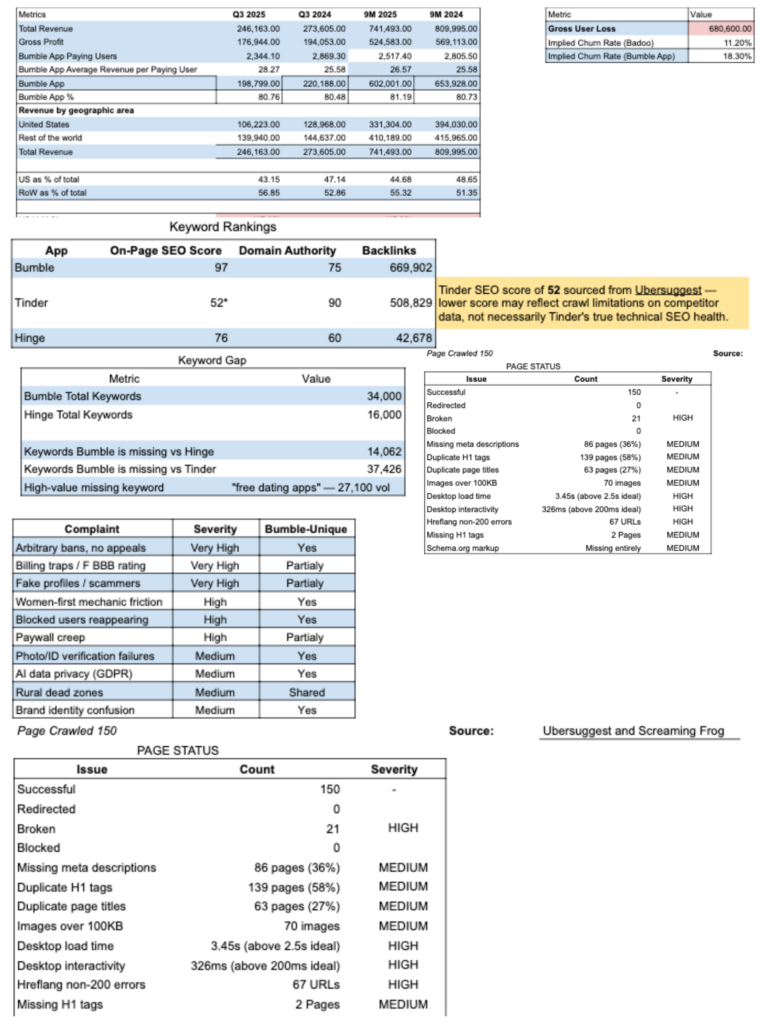
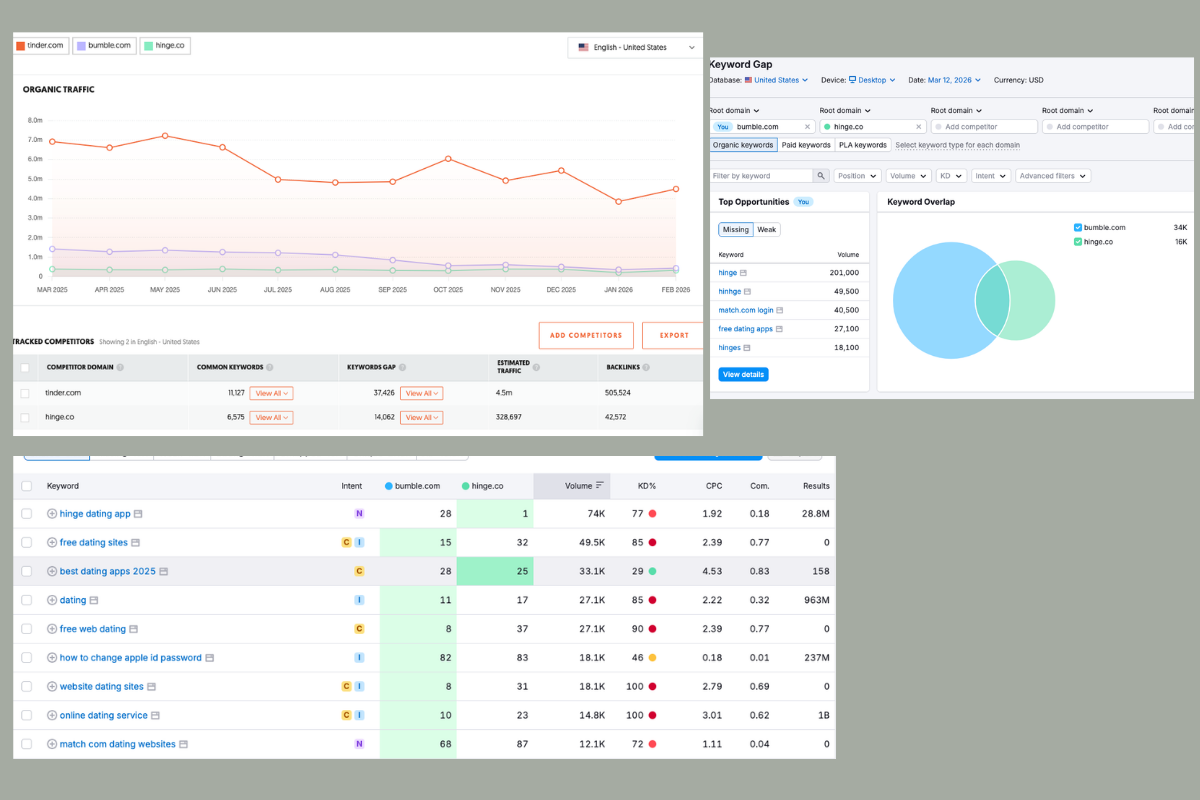
Bumble ranks #1 for its own name. It does not rank for how people actually search when they don’t already know which app they want. Keywords like “free dating apps” (27,100 monthly searches) and “free dating application” (40,500 monthly searches) return no Bumble result in the top 100. Against Tinder, Bumble is missing 37,426 keywords. Even against Hinge — a smaller brand with fewer backlinks — Bumble is missing 14,062 keywords.
The Screaming Frog crawl of 150 pages uncovered the structural reasons why:
- 86 pages (36%) have no meta description — Google is writing its own snippets for a third of the site
- 139 pages (58%) have duplicate H1 tags — search engines cannot differentiate between pages
- 63 pages (27%) have duplicate page titles
- 21 internal broken links (4xx errors)
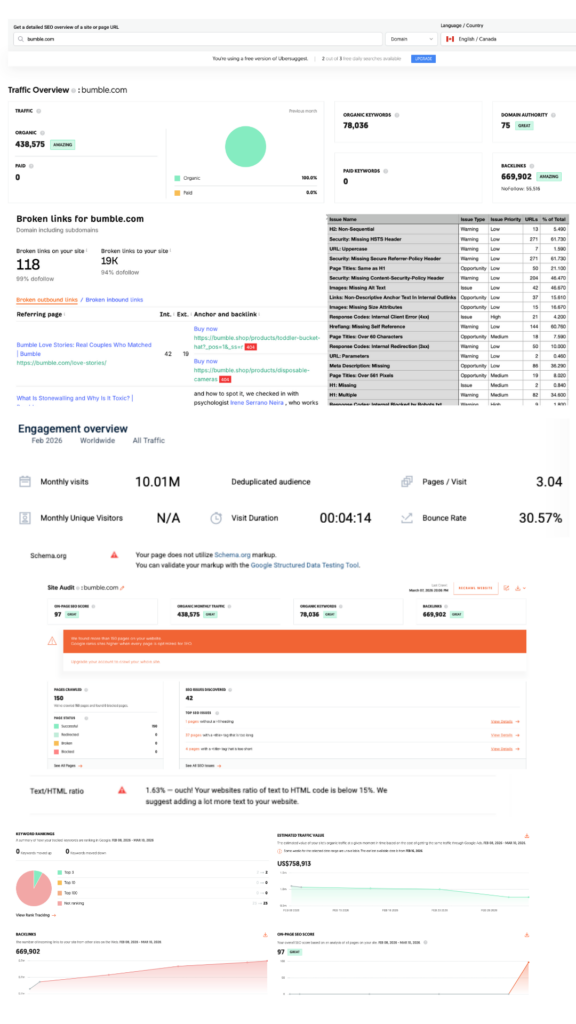
- Homepage text-to-HTML ratio: 1.63% — critically below the 15% threshold, meaning there is almost no indexable content on the most important page of the site
Site speed compounds the problem: desktop load time sits at 3.45 seconds, above the 2.5 second threshold where conversion rates begin to fall meaningfully.
Perhaps most telling: Bumble has zero paid search keywords. While slashing its marketing budget, it also abandoned paid acquisition entirely — meaning there is no channel actively bringing in users who don’t already know the brand exists.
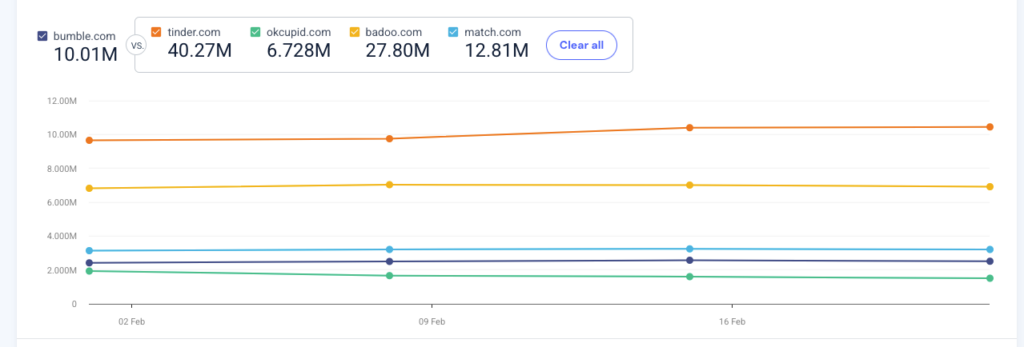
Compared to competitors, Bumble’s organic traffic of 438,575/month sits far behind Tinder’s 4.5 million/month, despite Bumble having more backlinks than Tinder. The backlink authority is there. The content strategy to convert it into traffic is not.
Part 3 — The Salesforce CRM Simulation
To make the financial data actionable, I built a CRM funnel simulation in Salesforce Developer Org to model where Bumble’s conversion and retention pipeline breaks down.
The funnel stages were mapped to Bumble’s actual user journey:
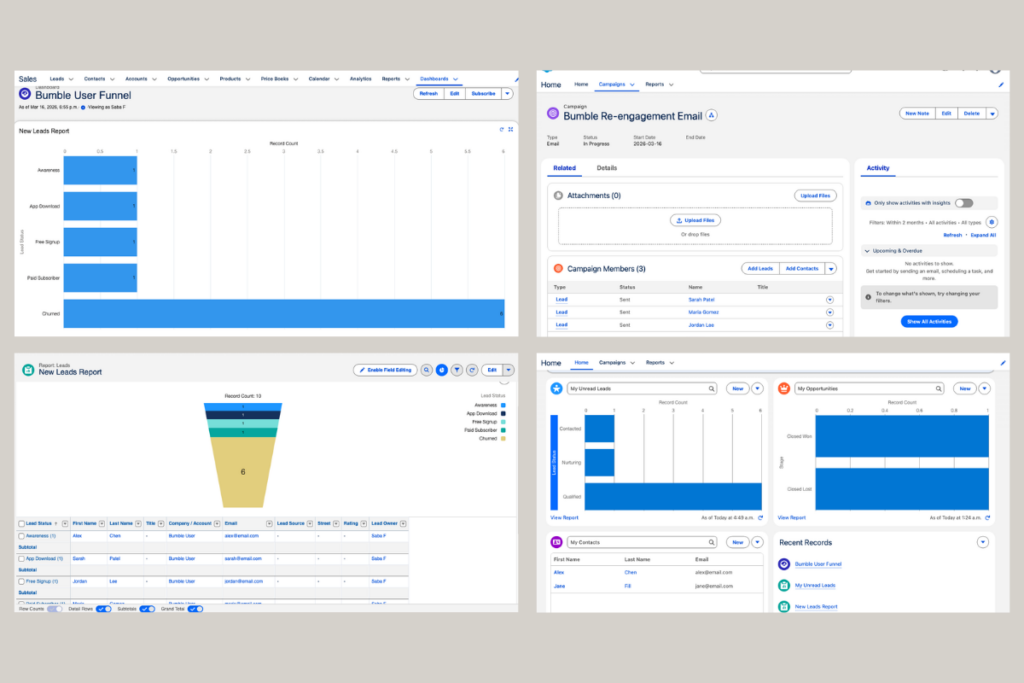
Awareness → App Download → Free Signup → Paid Subscriber → Churned
Using real paying user numbers from the SEC filing as the basis for each stage, the simulation makes the drop-off visible in a way that spreadsheets alone do not. The jump from Free Signup to Paid Subscriber — and then from Paid Subscriber to Churned — is where the 680,600 user loss lives in operational terms.
Alongside the funnel, I built a Bumble Re-engagement Email Campaign object in Salesforce to demonstrate what a MarkOps re-engagement workflow should look like. The campaign targets the churned user cohort — the 680,600 users lost in Q3 2025 — with a simulated email outreach sequence. Campaign members were assigned lead statuses of Sent, with the campaign description tied directly back to the financial data: a 90-day inactivity trigger targeting lapsed paying subscribers at the $22.64 ARPPU recovery value.
This is the piece Bumble’s marketing operations is missing: a structured, trackable system that connects churn data to a re-engagement action. Right now, those 680,600 users leave and nothing catches them.
Part 4 — Zapier — Automation Gap Analysis
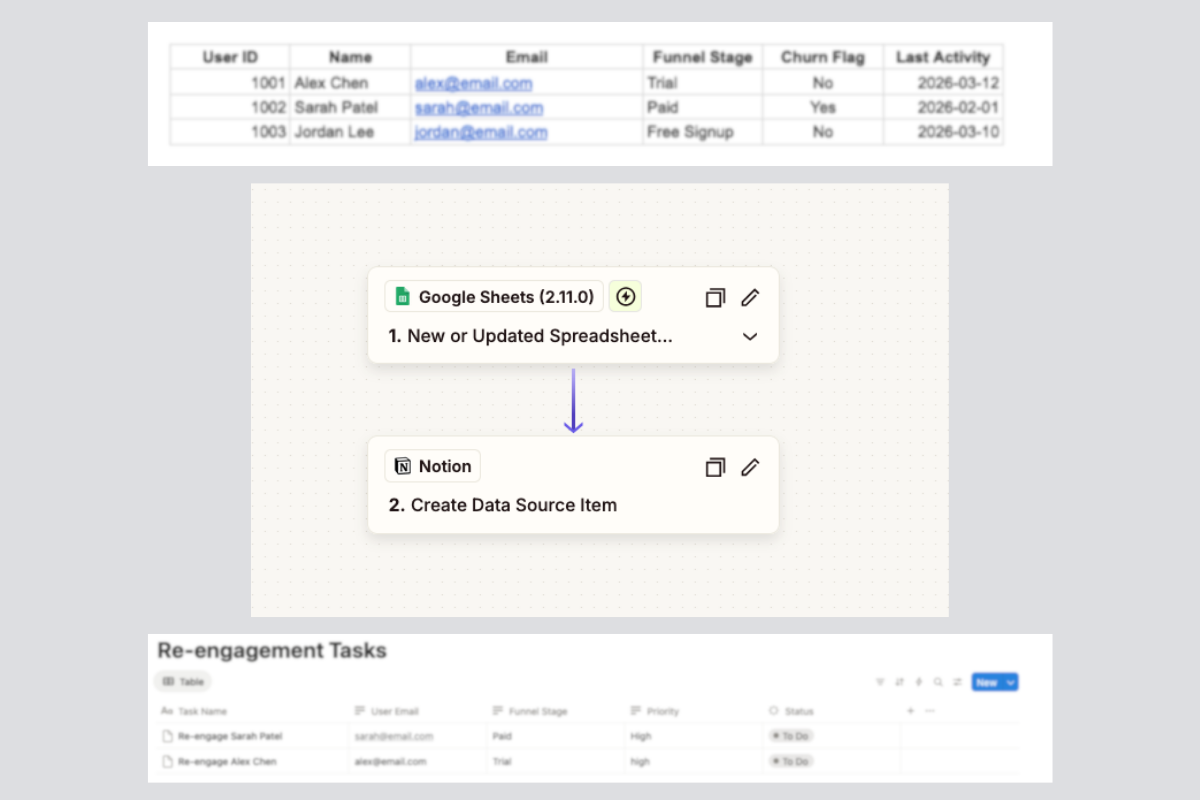
As part of the analysis, a lightweight marketing operations workflow was designed to illustrate the gap between Bumble’s current user lifecycle management and a more automated, data-driven approach. A proof-of-concept automation was built using Zapier, where a churn signal (simulated via a new row in Google Sheets) triggers the automatic creation of a re-engagement task in Notion / ClickUp. This demonstrates how marketing and lifecycle teams can operationalize churn signals in real time, reduce manual dependency, and enable faster, more consistent re-engagement efforts. The exercise highlights the role of automation in closing execution gaps, improving response time, and building scalable retention systems within a modern MarOps function.
Part 5
Findings & Recovery Roadmap
The 5 Failure Points
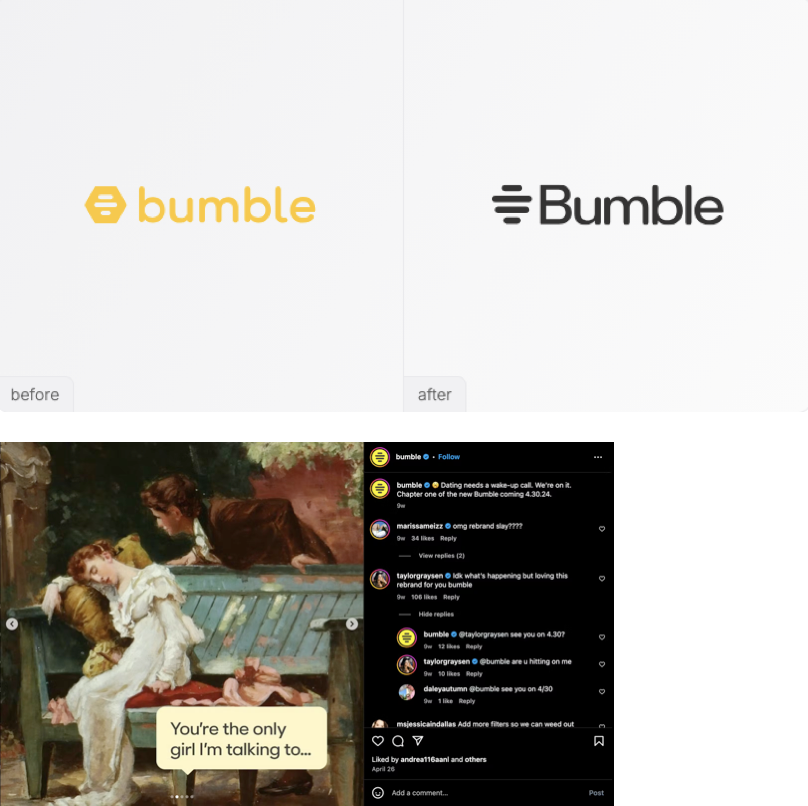
Brand Identity Collapse: The 2024 rebrand had the right instincts. The new logo was cleaner, the Instagram campaign showed genuine wit — deleting old content and announcing a new voice with humour that resonated with the frustrations of modern dating. The “Opening Moves” feature, new dating intention badges, and updated algorithm were real product improvements.
The execution is where it fell apart.
Bumble’s anti-celibacy ad campaign generated the kind of backlash that erases brand equity overnight. A dating app telling its audience what to do with their personal lives crossed a line that no amount of clever copy could recover from. According to CARMA, sentiment shifted from 38.7% positive / 11.7% negative to 2.2% positive / 77.4% negative — a 96.6% collapse in positive sentiment following the campaign launch. Bumble had built a brand on empowering its users. This campaign did the opposite.
SEO Regression
Bumble scores 97/100 on technical SEO. That score is misleading.
A high technical score measures whether the site is built correctly — it does not measure whether the site is findable. On the keywords that actually matter for user acquisition, Bumble is largely invisible:
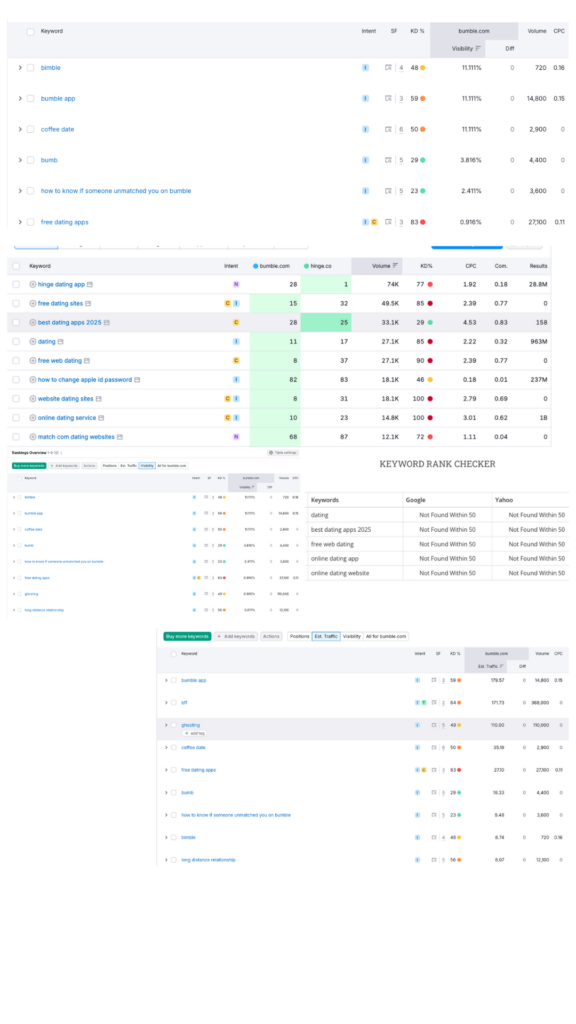
- “dating” — Not found within top 50 on Google or Yahoo
- “best dating apps 2025” — Not found within top 50
- “free web dating” — Not found within top 50
- “online dating app” — Not found within top 50
For the keyword “free dating sites”, Bumble has 15 keyword variations ranking. Hinge has 32. Bumble also ranks #10 for “dating” globally — meaning nine other results, including Facebook Dating, appear before Bumble for the most generic possible search term in their category.
The Screaming Frog crawl reveals why: 86 pages have no meta description, 139 pages share duplicate H1 tags, and 63 pages have duplicate titles. Google cannot differentiate between a third of Bumble’s site. The homepage itself has a text-to-HTML ratio of just 1.63% — there is almost no indexable content on the most visited page of the site.
Meanwhile, Bumble has 118 broken outbound links and 19K broken inbound links — meaning both users and search engines are hitting dead ends across the domain.
Rank tracking data as of March 17, 2026 shows Bumble’s overall search visibility sitting at 42.43% across tracked keywords — capturing less than half of their potential search presence. Most telling: Bumble ranks 13th for “bff” with 368,000 monthly searches, yet captures an estimated 171 visits from it. They own the BFF product. They are invisible for the search term that should define it. For “free dating apps” — 27,100 monthly searches — they rank 9th and capture approximately 27 visits. The gap between ranking position and actual traffic confirms that the problem is not just where Bumble appears in search. The content, meta descriptions, and page experience are failing to convert impressions into clicks.
Funnel Leakage
Paying users fell 16% year-over-year — 680,600 users lost in a single quarter. The data points to two compounding failures: Bumble cannot convert free users to paid, and it cannot retain the paid users it already has.
The retention failure is not a mystery. The sentiment data collected from Trustpilot, Reddit, and press coverage shows the same complaints surfacing repeatedly: arbitrary account bans with no appeals, blocked users reappearing in feeds, and billing issues with no phone support. These are not edge cases — they are structural trust failures.
The platform prioritization mismatch makes it worse. Bumble’s team is visibly active on Reddit, responding to user complaints informally. On their own Instagram — where paying customers leave public complaints — there is silence. When a company’s support infrastructure is more present on a third-party platform than its own channels, the retention system has broken down.
Bumble vs Hinge — the gap in numbers:
| Metric | Hinge | Bumble |
| Total users | ~30M | ~50–60M |
| Paying users trend | Growing | Declining |
| Revenue growth | +25–38% | -8% to -10% |
| Strategic momentum | Scaling globally | Restructuring |
Automation Gap
Bumble’s marketing automation infrastructure shows no evidence of functioning re-engagement workflows. The data reveals three specific gaps:
No paid acquisition. Bumble has zero paid search keywords. Every user who searches “best dating app” or “free dating apps” and doesn’t already know Bumble exists will never see a Bumble result — paid or organic.
No churn recovery trigger. 680,600 paying users churned in Q3 2025 alone. There is no visible automated re-engagement campaign catching these users before they leave or after they go. A basic 90-day inactivity trigger with a re-engagement email sequence — the kind modelled in the Salesforce simulation in this project — would be standard MarkOps practice.
No cross-platform response system. User complaints on Instagram go unanswered while the same team responds informally on Reddit. Without a unified customer response workflow, trust damage accumulates silently on the platforms that matter most to brand perception.
Competitor Ceding
Hinge is not just growing — it is absorbing the demand Bumble is failing to retain.
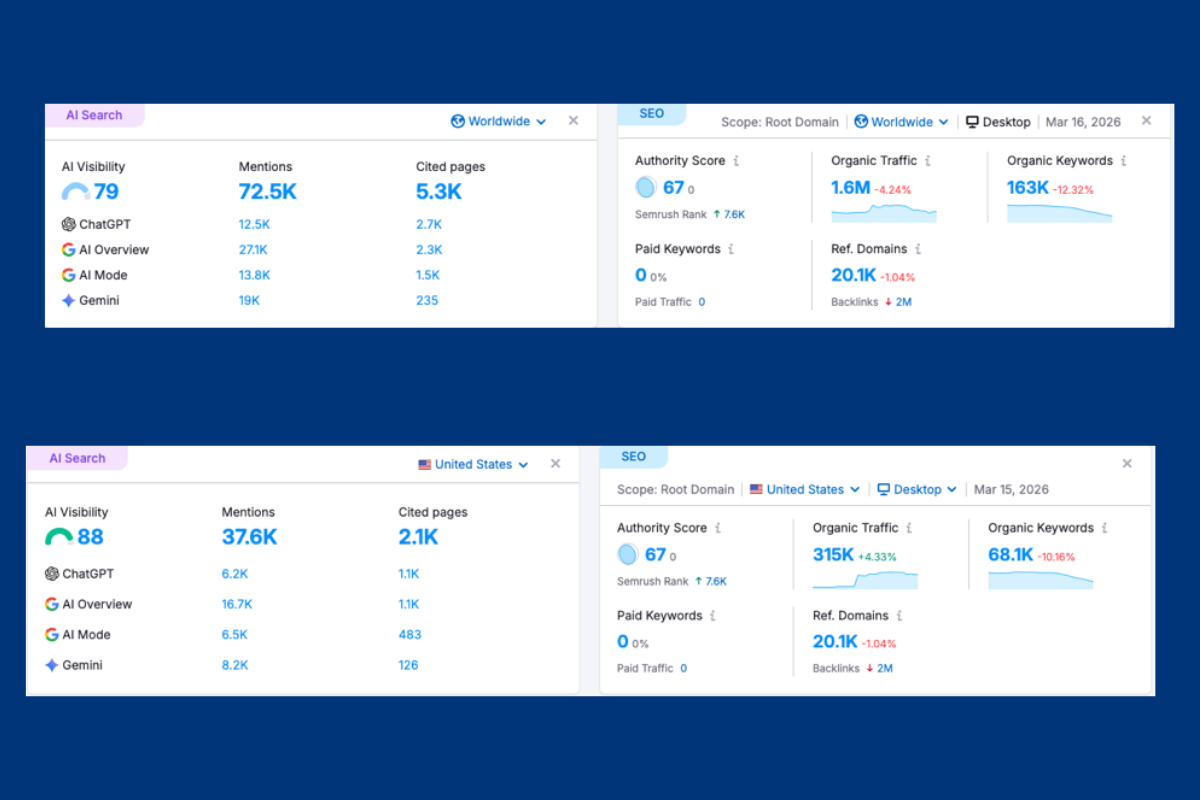
Bumble’s keyword rankings declined post-rebrand, and Hinge moved into the space they vacated. On AI search visibility, Bumble scores 79 worldwide while Hinge scores 88 in the US alone — a smaller brand with stronger intent-based presence where it counts most.
The positioning story is equally stark. Bumble spent 2024 debating celibacy in its ad campaigns. Hinge spent 2024 executing on “designed to be deleted” — a clear, emotionally resonant message for users who want serious relationships. Bumble’s core audience didn’t leave dating apps. A significant portion of them moved to Hinge.
Bumble has more users, more backlinks, and higher domain authority. Hinge has better positioning, better keyword strategy, and growing revenue. The competitive gap is not a resource problem — it is a focus problem.
Recovery Roadmap
The recovery has to start one level deeper.
Bumble’s current strategy is betting on AI. The data collected in this project suggests that is the wrong answer to the right question.
The question is real: how does a dating app differentiate itself in a saturated market where every competitor offers roughly the same product? Bumble’s answer — an AI matchmaking assistant to reduce user effort and improve match quality — assumes the problem is a feature gap. The data says otherwise. Bumble lost 680,600 paying users in a single quarter not because the algorithm was weak. They lost them because users stopped trusting the platform. An AI layer on top of a broken trust foundation does not fix the foundation. It adds another thing to pay for on an app that has already been accused of paywall creep, unresolved billing issues, and blocked accounts reappearing in feeds.
01 — Visibility Before Growth
The SEO infrastructure is broken where it matters most
What the data shows: 42.43% search visibility. Not found within top 50 for “dating,” “best dating apps,” or “online dating app.” Bumble ranks 13th for “bff” — their own product — with 368,000 monthly searches, capturing 171 visits. Position without content is a door with no sign on it.
The fix: Content strategy built around acquisition intent, not brand recognition. Hinge ranks for “long distance relationship,” “how to start a conversation,” “what to say on a first date” — meeting users at the moment of emotional intent. Bumble has the domain authority to own this space. They are simply not using it.
Tools: Screaming Frog (broken links + meta descriptions) · Semrush (37,426 keyword gap vs Tinder) · Schema.org markup · SEO content team
02 — Retention Before Acquisition
There is no point filling a funnel that leaks
What the data shows: 18.3% implied churn — nearly double the healthy SaaS benchmark. Zero paid acquisition keywords. 680,600 users left in a single quarter with no visible automated workflow to catch them.
The fix: Automated touchpoints at every drop-off stage. Free users who don’t convert within 30 days enter a nurture sequence. Paying users inactive for 90 days trigger a re-engagement campaign — personalised, not generic. The goal is to make users feel seen, not sold to.
Tools: Salesforce CRM funnel (modelled in this project) · Re-engagement email campaign (simulated in this project) · 90-day inactivity trigger · Zapier workflow routing churn signals to re-engagement tasks
03 — Trust Before Everything
This is the part no tool fixes on its own
What the data shows: Sentiment fell from 38.7% positive to 2.2% positive after the anti-celibacy campaign. Instagram complaints sit unanswered while the support team responds informally on Reddit. Social traffic is just 1.51% of total visits — every unanswered public complaint is a conversion that never happened.
The fix: Go back to the original question Bumble was built to answer — what do women actually need from a dating app that they are not getting anywhere else? The answer in 2026 is the same as 2014: safety, respect, and the feeling that someone is paying attention. At a moment when every competitor is pivoting to AI, a brand that leads with genuine human connection stands out completely. That is not a soft brand play. It is a direct competitive advantage.
Tools: Customer support SLA across all public channels · Transparent moderation policy · Zapier/Salesforce Flow routing Instagram complaints to support within 24hrs · Campaign built around human connection, not AI matchmaking
The Sequence
Rebuild trust → funnel stabilises → SEO compounds.
These solutions work in order, not in isolation. The infrastructure already exists — the Salesforce funnel, the re-engagement campaign, the SEO audit. These are not new tools. They are underused ones.
AI adoption will not fix a trust deficit. Bumble cannot automate its way back to a brand users believe in — and adding an AI matchmaking layer on top of unresolved complaints, unanswered Instagram comments, and blocked accounts reappearing in feeds will only deepen the frustration it was meant to solve.
Bumble does not need to become a different company. It needs to become the company it said it was.
What this Project Demonstrates
This audit was built entirely from public data — no proprietary access, no internal tools, no guesswork. Every finding is sourced, every number is verified against its original source, and every recommendation connects directly back to evidence collected in this project.
The conclusion is not that Bumble is beyond saving. It is that the marketing operations infrastructure — the systems, the signals, and the workflows that should catch a decline before it becomes a collapse — either were not in place or were not being used. That gap is fixable. This project shows how.
Tools used across this project:
SEC EDGAR · Zoho Sheets · Screaming Frog · Ubersuggest · Ahrefs · SimilarWeb · SEOquake · Semrush · Salesforce Developer Org · Zapier · Canva · Nano Nets (banner design)
A note on AI tools:
AI tools were used in this project transparently and in a supporting role. Claude AI assisted with text refinement, structural flow, and data correction. ChatGPT was used to learn unfamiliar tools — including SEO concepts, Screaming Frog interpretation, and Zapier — and to verify information during the research phase. SEO is not my core background, and I used AI to understand what the data was telling me, not to generate the data itself.
All data collection, analysis, Salesforce simulation, SEO auditing, and the core findings and recommendations in this project are original work — the AI helped me learn faster and communicate more clearly, not replace the thinking behind it.
This is how AI should work in a MarkOps context: as an operational support layer that closes skill gaps and improves execution, not a substitute for curiosity, research, and judgment.